


Bringing a Miniature Lighthouse to Life

Updated: Feb 16
I. IN-CAMERA OR IN-POST?
The final scene of the award winning Glass Poets short film, NAUÐR, required a pivotal location with a forlorn lighthouse. We filmed in Iceland during the winter, with roughly 4 hours of dim light each day. The lighthouse that I wanted to shoot was a 6.5 hour drive from our production and getting there was impossible on our schedule.

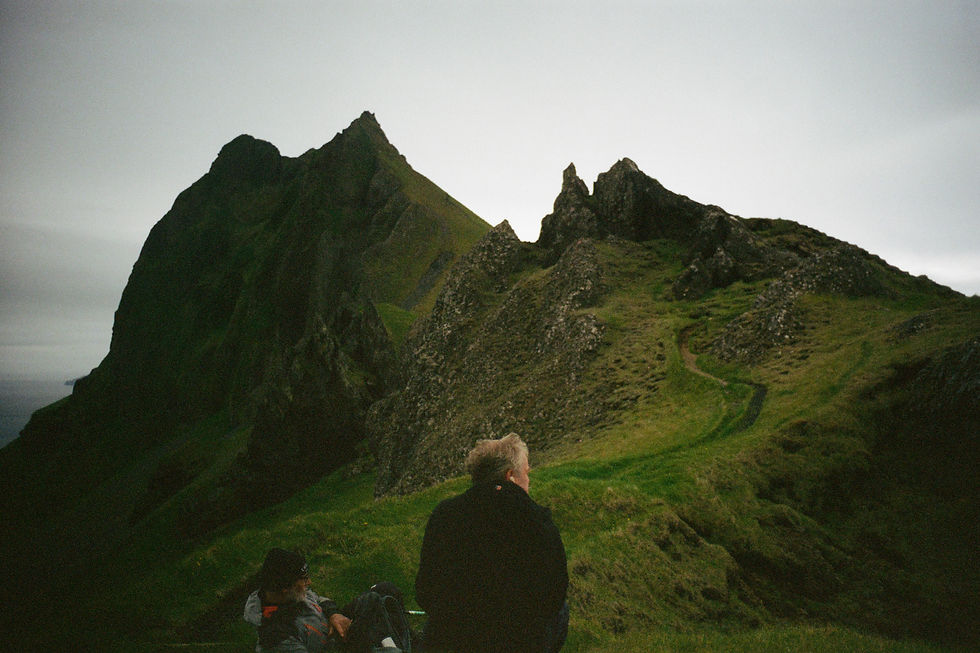
So, we planned for a computer-generated lighthouse. We selected a cliff that jutted out into the Icelandic sea with a beautiful swoop. It looked tailor-made for a remote and forgotten lighthouse. Filmed on location by Nauðr DP Chris Amodio.
Early look-dev by Mark Jabourian.
During post-production, I worked with Mark Jabourian, a CG Generalist and a long time collaborator, on models for a CG lighthouse. We tested a number of designs.
As we continued look-dev (look developement), something felt off. A fully CG lighthouse could look convincing, even photoreal with the right amount of work, but the essence of it wasn't right for Nauðr. The film is an ethereal-Tarkovskian-dream-scape, filmed all on location with non-actors. A CG lighthouse didn't compliment the raw performances and elements of wind, snow, and water we experience in the film.
I recalled watching the making-of features for the Lord of the Rings as a kid. The miniatures in those films had felt so ALIVE, so TEXTURED, so REAL!
I thought... why don't we build a lighthouse?
II. MINIATURE CONSTRUCTION

I revisited references of Dalatangaviti -- the odd, quaint lighthouse I wanted to shoot on location. It is Iceland's oldest lighthouse, basically a shack. It's extremely rustic, weathered, human, real.

I sketched out some ideas inspired by the Dalatangaviti lighthouse. I visualized a pronounced tower with a cupola inspired by iconic Icelandic lighthouses. Mark modeled my design in 3ds Max.

Originally, I intended to construct the lighthouse at 1:12 scale, but that resulted in a larger structure than our timeline and budget afforded. We used 1:24 scale instead. The resulting structure was about 25cm (9.8 inches) tall.

I set to building the lighthouse in the Boom Creative shop with assistance from my dad, Tom Ryan. It felt like the good ole' days when we built lightsaber props together in the local theatre shop.
Material employed:
HOUSE: Foam board; textured
LIGHTHOUSE COLUMN: PVC covered in modeling foam; rolled in gravel
DOOR: Small piece of balsa wood
ROCK WALL & CHIMNEY: Cut and textured foam board
THE ROOFING PANELS: 8.3oz aluminum bean cans
CUPOLA GLASS: Plastic water bottle
CUPOLA PLATFORM: Plastic lid (from the modeling foam container)
CUPOLA ROOF: Cardstock precisely scored, cut and folded
LIGHTHOUSE LENS: Harbor Lights 4th Order Fresnel Christmas ornament
The roof was the most difficult material to solve. I needed something that looked like real corrugated metal panels, but at 1:24 scale. After numerous failed attempts, I walked into the kitchen for a snack. I saw a small can of Bush's Baked Beans... removing the label, I discovered the ribbed section of the bean can was the perfect scale for our roof panels!

Effective, realistic miniatures require exceptional detail. This is why the Lord of the Rings miniatures excelled: they could hold up to intense scrutiny at a massive scale.
To create fine detail, we added actual rust shavings from the shop floor to roof panels; we glued model-railroad moss in wedges and between stones; we dirtied the windows with fake cracks and grime. The roof is patched with specular (shiny) and diffuse (not-shiny) sections, which gives it a weathered, metallic look. The white-washed walls feature reddish stains, as though water has been leaking off the rusty roof.

III. PUTTING IT ALL TOGETHER
On location, we captured a photoscan of the geography with a drone. This enabled Mark to create 3D geometry of the cliff and precisely map out the placement of the camera.

These calculations gave us the exact distance and angle for 1:24 miniature photography.

Sam Eisenhower, another longtime collaborator, filmmaker, and VFX specialist, served as our miniature unit cinematographer. We matched the lighting to the clean plate as closely as possible, and then captured each source as a distinct lighting pass, enabling Mark to balance the individual channels in Nuke.
Lighting passes left to right: beauty; ambient; direct; emissive
On location, we captured our plates as nodal-pans. This allowed us to use 2D tracking to place the final lighthouse composite, with no concern over parallax.


Throughout the process, I was nervous that the lighthouse wasn't going to look real enough to keep the audience convinced. But in the end, the miniature was so compelling, I wished we had more shots to composite -- just to find out how close we could get and maintain visual fidelity!
Digital tools are ubiquitous and it's easy to rely on them without considering alternatives. Ultimately, the decision between digital and practical effects should be guided by the story. A handcrafted, miniature lighthouse served the tone and spirit of our narrative. It allowed us to enhance the final scenes of Nauðr to something more raw and authentic than we had ever conceived. And in a largely digital pipeline, the process of bringing VFX to life by hand was simply invigorating.
Learn more about the film HERE.


Comments